
Avoiding a Nasty Wipe Out in Your Business During the First Wave of Artificial Intelligence
The first wave of AI is imminent and it's going to hit your business like a tsunami unless you prepare today.


Hey folks, in this week’s newsletter, I’ve got a simple 3-step plan for how to avoid your business getting wiped out by the first wave of new AI products and features.
Many people have been using ChatGPT in a business context and are getting great results for generating and summarising long documents.
But this is just the beginning.
In the coming months, there are going to be hundreds, if not thousands, of generative AI apps coming to market, many built on the very same underlying models from OpenAI, Anthropic and Google.
How can you prepare your organisation for this “AI onslaught” and even profit from it?
Let’s dive in and find out!
In the coming months, a tsunami of AI-enabled applications and products are going to be vying for the attention, and dollars, of your business.
I have no doubt that these new generative AI products, powered by models from OpenAI, Google, Anthropic and others, are going to allow first movers to make huge productivity gains and some to even slim down parts of their workforce by replacing lower-level cognitive jobs previously done by humans, with AI.
But for the most part, in the short-term, at least, those losing their jobs are not going to be replaced directly by AI, but by a person - may be at a more efficient competitor or perhaps even a more efficient co-worker sitting in the cubicle opposite - who is using AI.
In short, people using the new AI copilot software may be doing the work of two, three or potentially even more non-AI-enabled staff.
In cost-generating parts of a business, this could lead to job cuts.
However,
In revenue-generating parts of a business, where more resources and capability equals more revenue, this might actually lead to more jobs as companies scale up.
From another viewpoint, as I reported in a previous newsletter,
“IBM CEO Arvind Krishna said he could “easily see” nearly one-third of the company’s non-customer-facing roles being replaced (by AI) in the next five years.”
Some experts are concerned that this could lead to mass layoffs of previously “safe”, typically middle-class jobs.
The issue is not so much that technology is reshaping the workplace, it’s that the rate of reshaping is likely going to happen too fast to replace the lost jobs with new AI-aligned/resistant roles, causing an employment gap.
The other thing that sets AI apart from past technological advances, as Yuval Noah Harari has observed, is that AI is both,
“The first technology ever that can make decisions by itself”, and
“The first technology ever that can create new ideas”
If you work in an industry which is close to one hundred per cent cognitive in nature, for example, marketing, finance, law, accounting, or computing - you are likely to see the impact of AI much earlier than industries where a proportion of the work requires some sort of physical labour.
Occupations such as installers, plumbers, electricians, and gardeners are less likely to be directly impacted by AI in the immediate future.
However, those employed in these industries shouldn't become complacent.
If a significant number of middle-class jobs do become obsolete due to AI advancements, the demand for these AI-resistant services might also decrease as fewer people will be able to afford them.
The future sounds both exciting and terrifying, and no doubt there will be winners and losers in the short term as the first wave of generative AI hits industries.
To ensure you are on the right side of history, in the remainder of this post, I’ve put together my thoughts on how to prepare for this imminent wave of AI.
Let’s find out how.
Planning for the first AI wave
Being prepared is one way to help reduce anxiety about an uncertain future.
In the remaining part of this week’s post, I’ll outline my simple 3-step plan to get your business AI-enabled and ready to surf the first wave of AI tech.
1. Prepare your business for AI
Implementing AI is not an overnight process.
New AI products are being released at a breakneck pace, meaning if you think it’s a “one and done” kind of implementation, you might be disappointed.
I believe it's more beneficial to view the transition of your organisation into an "AI-enabled organisation" as a continuous process.
This is because the scope and capability of AI products and tools are expected to explode in the upcoming months.
A simple AI prioritisation matrix
To start, it can help to have an understanding of where your AI automation priorities lay.
For smaller businesses, a simple method you can use is to create an “AI prioritisation matrix” (for larger businesses, I recommend you read this more detailed scorecard approach).
Start by mapping out the functions of your organisation.
Apart from your main product or service offering, they will likely include the following functions to a greater or lesser degree,
Legal
Sales
Marketing
Finance
HR
IT
Customer Service
Operations
Of course, if you want to break down each function further into tasks, then you can.
For example,
The “Legal” function might be broken down into the following tasks,
“Write new contract”,
“Review contract”,
“Search for contract”, etc.
Next, decide on a list of goals you are trying to achieve through using AI.
Although they can certainly guide you, it’s a good idea to be more specific and go beyond high-level objectives like “cost savings” and “higher productivity”.
Here are some lower-level objective examples you can use for AI, feel free to extend the list further,
Removal of repetitive or boring tasks and functions
Automating processes to reduce errors and improve quality
Improving customer service through personalisation
Driving better data-driven decision-making
Generating more revenue ideas and opportunities
Knowledge sharing of internal corporate documents and information
You are probably looking to hit a combination or all of these objectives across multiple function lines.
Next, arrange your business functions and objectives on different axes in a spreadsheet and rank each business function and objective between 1 to 5 for priority, 5 being the highest priority,
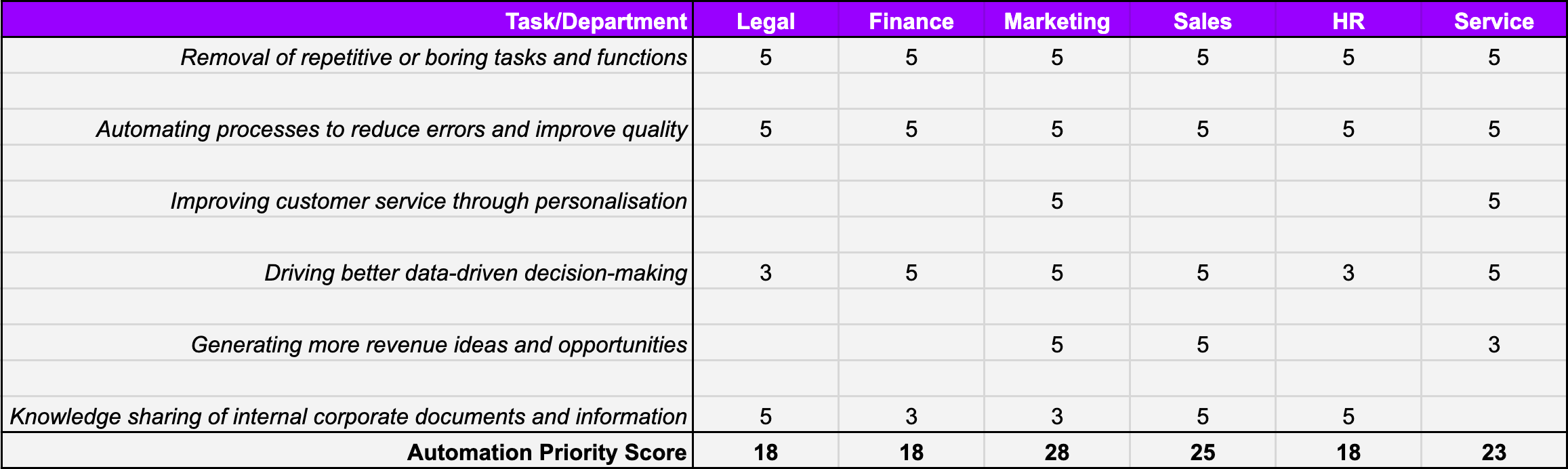
Finally, sum the priority score for each column for the function line to get an overall automation priority score.
The function lines with the highest priority score are where you start your automation journey. Share this with other team members, if you have them, to get a consensus on the results.
